You started with the free tier. Then your project got real, you needed more characters, and suddenly you're paying $22 a month. Then $55. Then you're doing the mental math: how many words is that, exactly, and why am I rationing my own narration?
ElevenLabs is genuinely good software. Nobody's arguing that. But if you're hitting limits, watching costs spiral with every audiobook chapter or podcast episode, or you're just uneasy about uploading your voice, your manuscripts, your unpublished scripts, to someone else's server, then yeah, looking around makes sense.
What to look for in an ElevenLabs alternative
Before jumping into the list, it's worth knowing what actually separates these tools, because the marketing copy all sounds the same.
Voice quality and emotional range. ElevenLabs set a high bar here. Alternatives vary wildly. Some sound robotic on anything beyond neutral narration. Look for tools that can handle pacing, emphasis, and tone shifts, especially if you're doing character work, audiobooks, or anything with more than one speaker.
Pricing model. Most cloud tools charge by character count or by "credits." This sounds fine until you're producing at any real volume. A single audiobook is roughly 500,000 to 800,000 characters. Do that math against a $22/month plan.
Privacy. This one doesn't get talked about enough. When you use a cloud voice tool, your voice samples and your text go to their servers. If you clone your own voice, that biometric data is stored somewhere you don't control, and an unpublished manuscript ends up in the same place. For a hobby project that may be fine; for professional work it is a real question.
What else it can do. ElevenLabs is primarily a voice tool. If you also need music, sound effects, editing, or any kind of audio production workflow, you're going to be paying for multiple subscriptions. Worth knowing before you switch from one single-purpose tool to another.

The main ElevenLabs alternatives in 2026
Play.ht
Play.ht is one of the cleaner cloud alternatives. The voice quality is solid, the interface is fast, and they have a large library of pre-built voices. Pricing is subscription-based with character limits, similar structure to ElevenLabs. The free tier is limited but functional for testing.
Good for: Quick TTS for short-form content, creators who want a familiar cloud workflow.
Less good for: High-volume production, privacy-sensitive work, anything beyond narration.
Murf AI
Murf positions itself more at the corporate and e-learning market. The voices are professional and clear, with good studio controls. The interface is polished. It costs more at the serious usage tier, and like all cloud tools, your content goes through their servers.
Good for: Professional voiceover, explainer videos, training content.
Less good for: Indie creators on a budget, anything requiring character voices or emotional range.
Resemble AI
Resemble is worth mentioning because their voice cloning is genuinely strong. You can clone a voice from a short sample and get good results. API access is available, which matters for developers. Pricing gets steep at volume.
Good for: Voice cloning work, developer integrations.
Less good for: All-in-one audio production, creators who want a GUI workflow.
Coqui TTS (Open Source)
Coqui is free and open source. If you're technical enough to run it yourself, you get solid TTS with no subscription. The tradeoff is setup complexity, less polished voices compared to the commercial options, and no production workflow around it, just the model.
Good for: Developers, people who want zero cost and full control.
Less good for: Anyone who wants a finished product they can actually use on day one.

Demodokos Foundry, the local option
This is the one that doesn't fit neatly into the "cloud alternatives to ElevenLabs" category, because it isn't cloud at all.
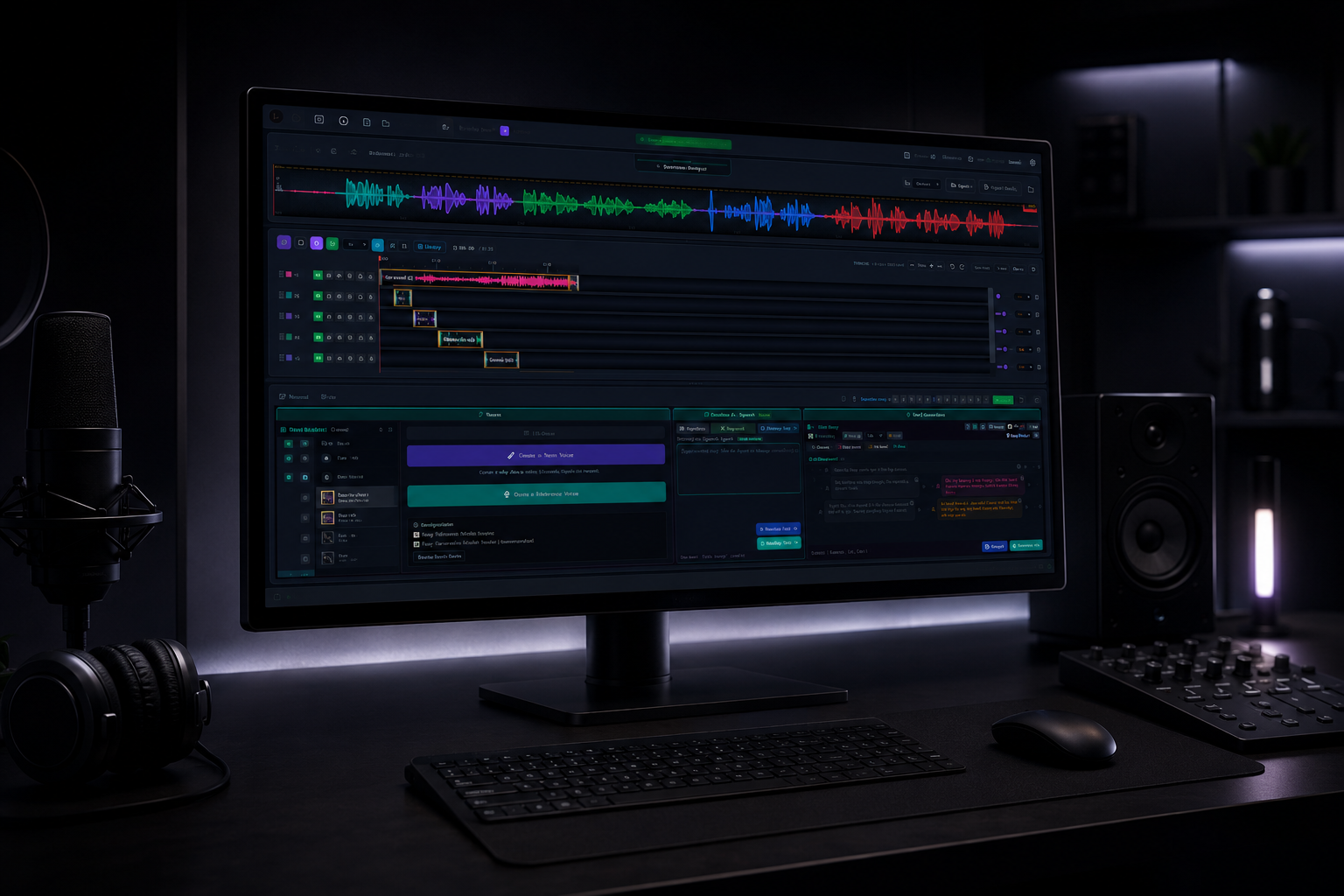
Demodokos Foundry runs on your own computer and your own GPU. Your scripts, voice samples and audio are never transmitted to Demodokos servers, and Demodokos does not monitor, inspect, record or log what you create. Generation is unlimited, so there is no character meter either.
The voice generation covers 38 emotions and speaking styles across drama, narration, and character states. It also includes multi-speaker support, which matters for audiobooks and podcasts where you need distinct, consistent character voices across hours of content. You can clone a voice from a short sample and direct the performance instead of hoping the default sounds right.
Voices from our library stay on your PC, where nobody can withdraw them. Here is how downloadable AI voices work.
But the part that separates it from every other tool on this list is what it does beyond voice. It's a complete audio production suite:
- AI music generation, any genre, unlimited
- Hundreds of DSP effects and audio modifications, including reverb, telephone filtering, and spatial audio
- A full timeline editor for multi-track mixing, trimming, fading
- Stem separation to extract individual elements from existing audio
- Patch, which lets you fix or change a specific section of a generated song without regenerating the whole thing
- A CLI and API for batch production if you're building automated workflows
The pricing is $12.00/month for the Creator plan when billed annually. There's a 7-day free trial.
For context: ElevenLabs at $22/month, Suno for music at $22/month and a sound effects library at $9/month add up to $53/month across three cloud tools, each with its own credit system and upload portal. Demodokos Creator is $12.00/month when billed annually, with voice, music and effects in one local app.
Foundry needs a decent GPU and runs on Windows only, so on a Mac or a low-spec machine, check the requirements before committing. And the speed advantage, up to 15x realtime generation, only shows up on stronger hardware.
Good for: Audiobook producers, podcasters, indie game developers, YouTube creators, anyone doing serious volume, anyone who cares about privacy.
Less good for: People on Mac or without a dedicated GPU.
Side-by-side comparison
| Tool | Pricing | Cloud or local | Voice cloning | Music generation | Multi-speaker | Unlimited generation |
|---|---|---|---|---|---|---|
| ElevenLabs | From $22/mo | Cloud | Yes | No | Yes (paid) | No, character limits apply |
| Play.ht | From $31.20/mo | Cloud | Yes | No | Yes | No, character limits apply |
| Murf AI | From $29/mo | Cloud | Limited | No | Yes | No, usage limits apply |
| Resemble AI | Usage-based | Cloud | Yes | No | Limited | No |
| Coqui TTS | Free (self-hosted) | Local | Yes | No | Limited | Yes |
| Demodokos Foundry | $12.00/month when billed annually | Local | Yes | Yes | Yes | Yes |
Which one should you choose?
If you want to stay in the cloud and just want something cheaper with less friction than ElevenLabs, Play.ht is probably your cleanest move.
If you're a developer who wants full control and doesn't mind setup complexity, Coqui TTS is worth the investment of time.
If you're producing at serious volume for audiobooks, podcasts, game dialogue, or YouTube channels, and you have a Windows machine with a decent GPU, Demodokos Foundry changes the math: it runs on your own hardware, keeps your files on your PC, and puts no limit on how much you generate.
Stop rationing your own narration.
Local voice generation, music production, and hundreds of DSP effects and audio modifications, all on your machine. Generate as much as you need, with no character limits and no credits to count.
Try Foundry Free for 7 DaysNo charge during the trial. Cancel anytime.
Prices from each provider's public plans, May 2026.